
How to Choose LED Downlight Beam Angle: Optical Performance - UGR Guide
Suzhou, Jiangsu Sep 7, 2026 (Issuewire.com) - Quick Answer
Selecting the right LED downlight beam angle depends on ceiling height, mounting height, spacing, target illuminance, space layout, and the intended lighting effect. Narrow beams (15°-24°) can concentrate light for high ceilings and accent applications, medium beams (30°-45°) provide a balance between intensity and coverage, while wider beams (60°+) can support more uniform general illumination. However, beam angle alone does not determine glare performance. UGR must be evaluated together with luminaire luminance, shielding, mounting position, room geometry, and observer position.
Key Takeaways
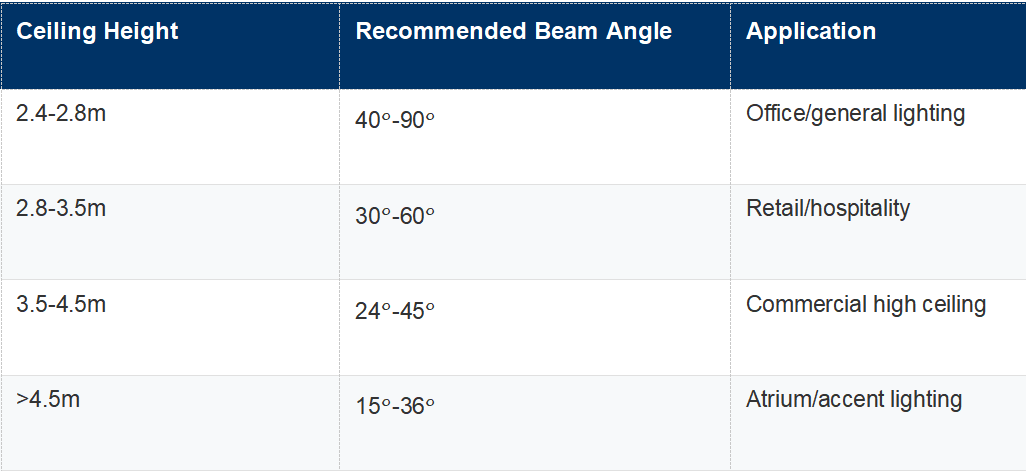
- Ceiling Height Dictates Optics:Higher ceilings (>3.5m) often benefit from narrower beams (15°-36°) because concentrated light distribution helps maintain sufficient illuminance at the working plane.
- UGR Compliance Matters:Wide-beam downlights without proper shielding or optical control can increase glare risk, especially in open-plan offices where luminaires are within occupants' direct viewing angles.
- Spacing Ratio Rule:Beam angle influences the practical spacing between downlights, but final fixture spacing should be determined from the luminaire's photometric distribution, mounting height, required illuminance, and uniformity target. SHR can be used as a practical starting point during layout design.
- COB vs. SMD Beam Distribution:Chip-on-Board (COB) LEDs with reflectors deliver precise directional cut-offs, whereas Surface Mount Device (SMD) arrays with diffused lenses spread wider, softer light across task surfaces.
- Optical Degradation Risk:Poor thermal dissipation in optical lenses accelerates yellowing and lumen depreciation (L70/L90 thresholds), distorting the intended beam spread over time.
Technical Q&A: Understanding Downlight Optics & Visual Comfort
Q1: What is an LED downlight beam angle, and how is it measured?
The beam angle (also called beam spread) is the angle between two planes where the luminous intensity drops to 50% of the peak center-beam intensity (measured in candelas).
In commercial lighting engineering, beam angle is distinct from Field Angle (where light intensity drops to 10% of peak). A fixture with a 36° beam angle may have a 60° field angle; ignoring the field angle often leads to unexpected visual glare in adjacent viewing angles.
Q2:How does downlight beam angle affect UGR?
Beam angle can influence glare potential, but it does not directly determine UGR. UGR is calculated from the luminance and position of luminaires within a defined room and observer geometry. A wide beam can increase the amount of light emitted at higher viewing angles when shielding is insufficient, while deep reflectors, baffles, and micro-prismatic optics can reduce direct views of the light source. For commercial projects, the final UGR should therefore be verified using the luminaire's photometric data and the actual room layout.
Q3: What is the technical difference between Narrow, Medium, and Wide beam angles?
The choice between narrow, medium, and wide optics alters the ratio of direct task illumination to ambient vertical illuminance:
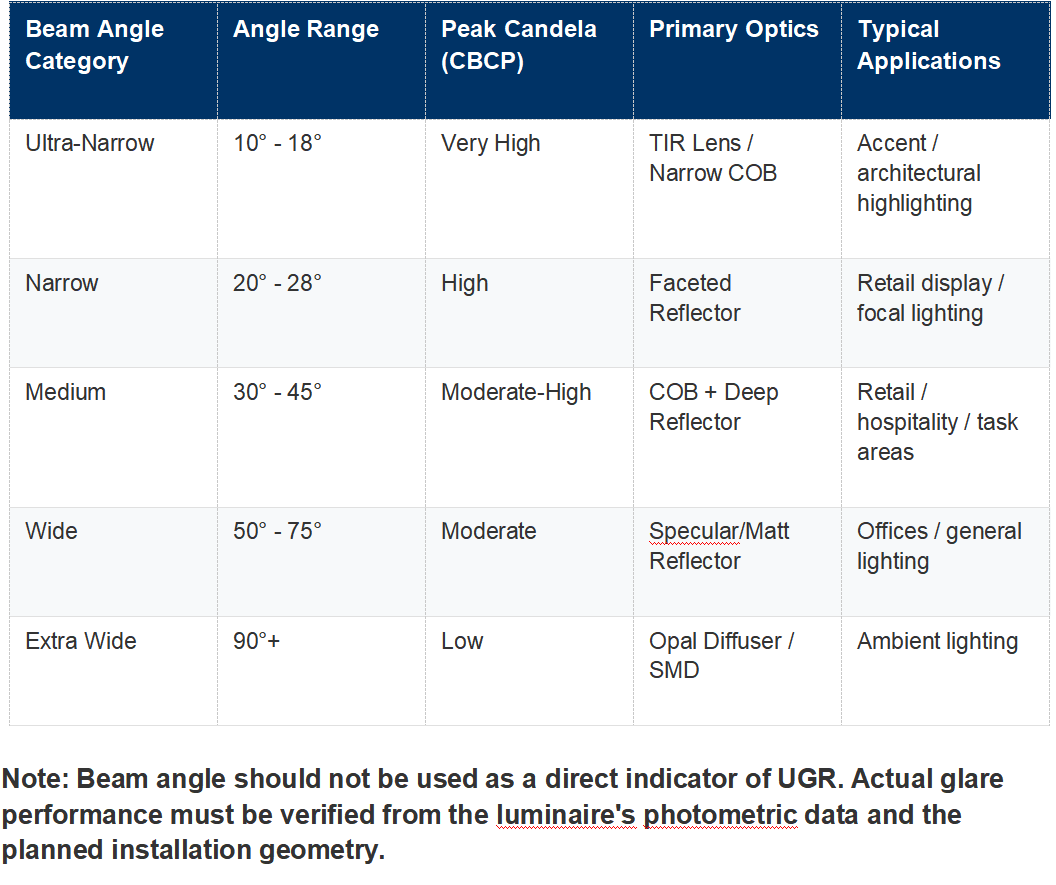
- Narrow Beams (15° - 24°):High peak candela, minimal spill light. Ideal for accent lighting, architectural highlighting, or high-ceiling concourses (>4.5m).
- Medium Beams (30° - 45°):Balanced intensity distribution. Creates distinct pools of light with soft transitions, perfect for retail merchandise aisles, hotel lobbies, and task areas.
- Wide Beams (60° - 90°+):Low peak candela spread over a large area. Designed for general ambient lighting where uniform lux levels across horizontal planes are required.
Expert Insight: In practical applications, COB-based optical systems generally provide better beam control and higher center-beam intensity than diffuse SMD solutions, especially for accent lighting and high-ceiling applications.
Q4: How do you calculate optimal downlight spacing based on beam angle?
To avoid hot spots or dark zones between fixtures, lighting designers calculate spacing using the Spacing-to-Height Ratio (SHR):
Maximum Spacing = SHR -- (Ceiling Height - Workplane Height)
- Narrow Beams (24°):Lower SHR (~0.5-0.7). Fixtures must be spaced closer together to maintain illuminance uniformity.
- Wide Beams (60°):Higher SHR (~1.0-1.2). Fixtures can be positioned further apart, reducing total fixture counts but increasing potential glare if cut-off angles are unshielded.
Technical Performance & Failure Mechanisms
When selecting downlight optical configurations for commercial installations, specifying the beam angle alone is insufficient. Optical performance deteriorates when secondary optical systems and mechanical designs fail.
- Failure Mechanisms in Commercial Downlight Optics
- Thermal Stress & Lens Yellowing:High junction temperatures (Tj > 85°C) in poorly cooled fixtures degrade PMMA or PC optical lenses. Optical yellowing reduces total light output and shifts color temperature (SDCM drift), distorting the calculated beam angle distribution over time.
- Driver Degradation & Ripple Current:Subpar LED drivers with high output current ripple cause microscopic flickering. This amplifies optical discomfort and glare perception, rendering low UGR reflector designs ineffective.
- Dust Accumulation on Recessed Optics:Open-reflector downlights installed in commercial spaces collect dust over thermal vents. Dust buildup on secondary optics scatters light, increasing spill light beyond the intended beam cutoff and raising UGR levels.
- Condensation & Moisture Ingress:In washrooms or high-humidity retail areas, non-IP rated optics suffer internal condensation. Water droplets act as secondary lenses, distorting beam angles and causing internal driver short-circuits.
- Relevant Industry Standards
Commercial downlight specifications must comply with internationally recognized testing and performance benchmarks:
- CIE 117: Discomfort Glare in Interior Lighting (Standardized UGR calculation method).
- EN 60598-2-2: Specific requirements for recessed luminaires (Thermal, mechanical, and electrical safety).
- IEC 60529: Ingress Protection (IP) rating classifications (e.g., IP44/IP65 for wet and dusty zones).
- IES LM-80 / TM-21: Testing methods for LED lumen maintenance and projecting long-term lumen degradation (L70/L90 metrics).
B2B Procurement Checklist: Downlight Optical & Architectural Specs
Before finalizing commercial downlight procurement orders, evaluate the fixtures against this engineering framework:
- Optical & UGR Certification:Are UGR calculations or reports available for the exact luminaire configuration and installation conditions, together with IES/LDT photometric files?
- Thermal Management: Is the thermal design adequate for the LED and optical system's specified operating conditions, with junction temperature controlled within the manufacturer's rated limits?
- Driver Performance: Is the LED driver flicker-free (Ripple Current < 3%), with Power Factor (PF) > 0.95 and THD < 15%?
- Ingress Protection (IP Rating): Does the installation require IP44 (standard indoor) or IP65 (splash-proof for restrooms/cleanrooms)?
- Lumen Maintenance (L70/L90): Is long-term lumen maintenance supported by applicable LM-80 data, TM-21 projections and relevant luminaire performance documentation?
- Color Quality Metrics: Does the fixture meet CRI 90 and SDCM 3 MacAdam ellipses for color consistency across all fixtures?
- Total Cost of Ownership (TCO): Does the high efficiency ( 110 lm/W) compensate for initial capital expenditure within a 24-month operating period?
Application Guide: Selecting Optics by Commercial Environment
- Commercial Offices & Educational Institutions
- Primary Objective: Eye comfort and productivity over 8-10 hour shifts.
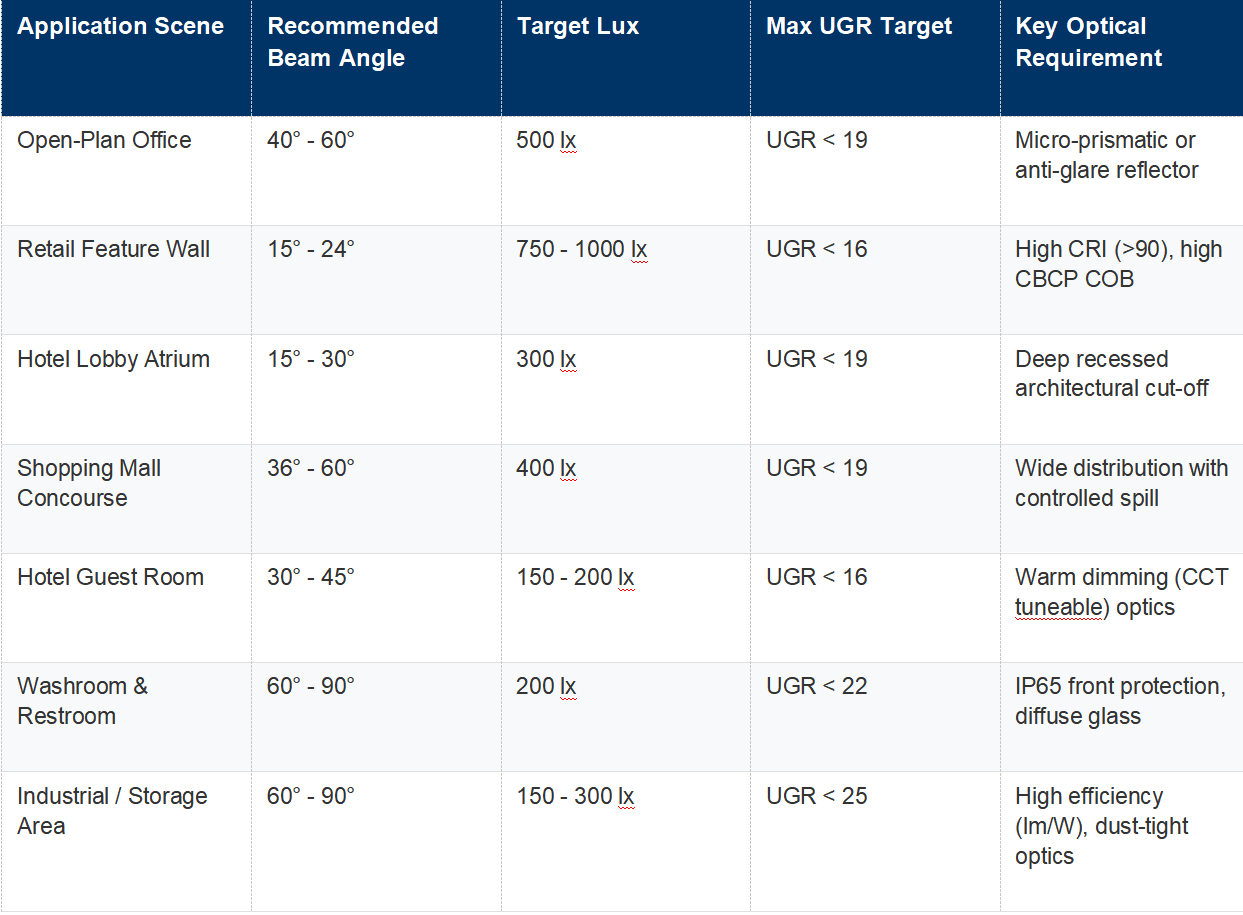
- Beam Strategy: Medium to wide optics (40°-60°) paired with anti-glare reflector cups or micro-prismatic optics to consistently achieve UGR < 19.
- Layout Rule: Align downlight spacing with desk arrangements to prevent direct reflections on monitor screens.
- Retail Stores & Shopping Malls
- Primary Objective: Visual hierarchy, drawing consumer attention to merchandise displays while maintaining ambient walkway comfort.
- Beam Strategy: Dual-layer optical approach. Fixed recessed downlights (36°-45°) handle general aisle circulation, while narrow-beam optics (15°-24°) accentuate promotional displays.
Integrated Lighting Synergy: In modern retail architecture, fixed downlights are frequently complemented by adjustable track lighting systems. Specifiers often integrate high-performance downlights alongside flexible IMIGY commercial LED track lights to create dynamic lighting schemes that adapt to seasonal layout changes without rewiring ceilings.
- Hospitality & High-End Residential
- Primary Objective: Ambiance, visual warmth, and architectural integration.
- Beam Strategy: Deeply recessed 30°-45° downlights with dark/specular baffles. The light source remains invisible from normal viewing angles, creating a clean ceiling aesthetic.
- Commercial Washrooms & Utility Zones
- Primary Objective: Safety, humidity resistance, and uniform coverage.
- Beam Strategy: Wide-beam optics (60°-90°) with IP65-rated sealed glass covers to prevent vapor ingress into the ceiling plenum.
High-Performance Optical Solution: IMIGY Commercial Lighting Portfolio
When commercial engineering demands precise optical distribution, low glare ratings, and robust thermal execution, standard off-the-shelf downlights often fall short.
To resolve these technical challenges, IMIGY engineered the Explorer Pro Downlight Series, offering a modular optical platform tailored for demanding architectural specifications.
Engineered Optical Architecture: Explorer Pro A / Pro B / Pro C
- IMIGY Explorer Pro A (Deep Anti-Glare Architecture): Specially engineered for high-end hospitality and executive offices. Featuring a deep-set COB light engine with dark specular reflectors, Pro A guarantees UGR < 16 while preserving crisp beam cut-offs.
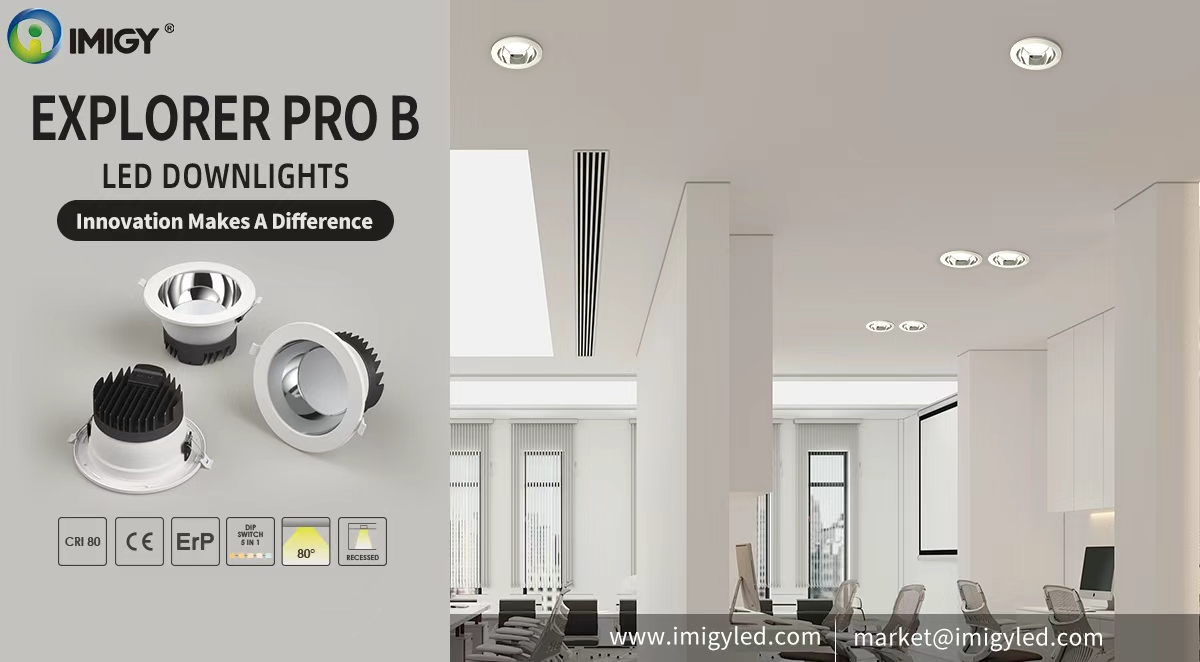
- IMIGY Explorer Pro B (High-Efficiency Precision COB): Modular beam options (15°, 24°, 36°, 50°) powered by high-density COB chips (CRI > 90, R9 > 50). Designed for retail display walls and accent focal points requiring high center-beam candlepower (CBCP).
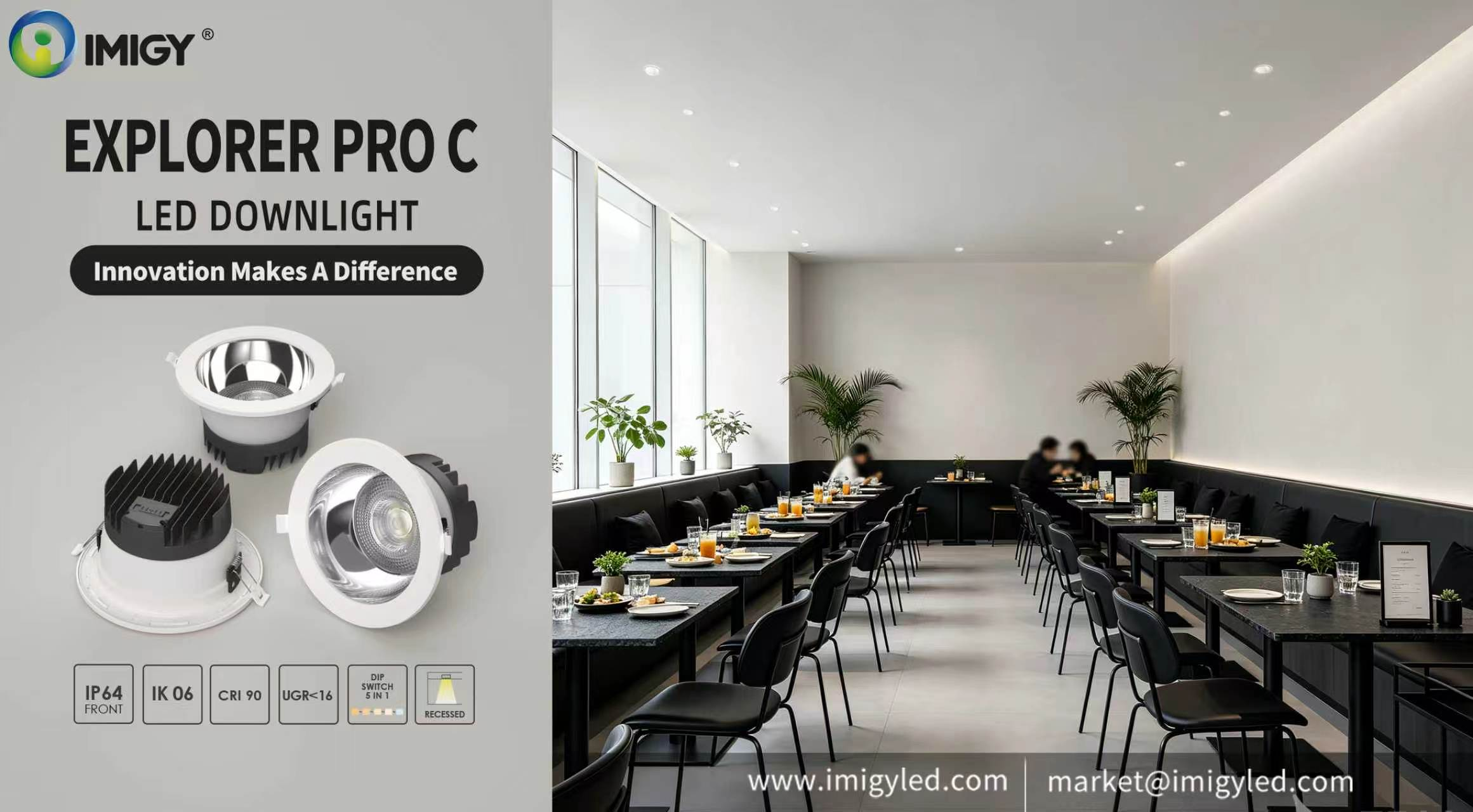
- IMIGY Explorer Pro C (Wide-Coverage Commercial): Engineered for open-plan workspaces and commercial facilities needing high visual uniformity and IP65 front protection. Utilizes micro-prismatic optical lenses to maintain UGR < 19 across wider spacing grids.
Comprehensive Commercial Portfolio Synergy
Beyond fixed recessed downlights, complex commercial spaces--such as retail flagship stores, art galleries, and modern car showrooms--require flexible directional spotlighting. By combining IMIGY Explorer Pro Downlights for general ambient baselines with IMIGY architectural LED track lights for dynamic focal highlighting, specifiers achieve a cohesive visual aesthetic with consistent color rendering (SDCM 3) across all fixture types.
Frequently Asked Questions (FAQ)
- What is the best downlight beam angle for a standard 2.8m office ceiling?
A 40° to 60° beam angle paired with a deep anti-glare reflector or micro-prismatic lens is optimal for a 2.8m office ceiling. This combination delivers target horizontal illuminance (500 lx) while maintaining UGR < 19.
- Is a wider downlight beam angle always better for general lighting?
No. Extremely wide beam angles (>90°) direct light at high cut-off angles into occupants' sightlines, creating glare (UGR > 22) and visual discomfort. Controlled optics (50°-60°) provide superior visual comfort while maintaining uniform ambient illumination.
- What is the difference between Beam Angle and Field Angle?
Beam angle is the measurement angle where light output drops to 50% of peak intensity. Field angle is where output drops to 10% of peak. Field angle represents spill light, which often contributes to unwanted direct glare if unshielded.
- How does COB differ from SMD in downlight beam delivery?
COB (Chip-on-Board) LEDs act as a single concentrated light source, allowing secondary reflectors or TIR lenses to shape narrow, precise beams (15°-36°). SMD (Surface Mount Device) arrays use multiple lower-power chips spread across a board, yielding wider, diffuse beams (80°-110°).
- What beam angle should be used for artwork or accent displays?
Accent displays require narrow beams (15°-24°) with high center-beam intensity and CRI > 90 to create a strong contrast ratio (typically 3:1 or 5:1) against ambient surround lighting.
- Why does my low UGR downlight still cause visual glare?
Glare can occur if the reflector surfaces accumulate dust, if low-quality drivers induce output current ripple flicker, or if downlights are installed too close to glossy or reflective surfaces, causing secondary ceiling glints.
- How does ceiling height affect beam angle choice?
As mounting height increases, narrower beam distributions can help maintain center-beam intensity and illuminance on the working plane. For high-ceiling applications, 15°-36° optics may be appropriate depending on the required coverage, mounting height, spacing and photometric distribution.
- What reflector finish is best for controlling glare?
Specular dark chrome, black baffles, and matt aluminum reflectors provide superior cut-off angles compared to bright white reflectors. White reflectors scatter spill light into high viewing angles, raising UGR values.
- What is the recommended UGR limit for commercial offices?
According to international standards like EN 12464-1, open-plan office reading and writing zones require a maximum UGR limit of 19. Technical drawing areas require UGR 16.
- Can I change downlight beam angles after installation?
Lumnaires with modular optical systems--such as the IMIGY Explorer Pro platform--allow field-interchangeable reflectors or TIR lenses, enabling engineers to swap beam spreads without replacing the luminaire housing.
- When should I use downlights versus track lights in a commercial layout?
Recessed downlights provide fixed general ambient lighting and structured architectural grid layouts. In contrast, adjustable track light fixtures are ideal for areas with frequent display changes, high vertical feature walls, or spaces where ceiling recessing is constrained.
- What is the role of TIR lenses vs. reflectors in downlight beam shaping?
Total Internal Reflection (TIR) lenses capture nearly all light rays emitted by the LED chip, offering tighter beam control and fewer spill light losses than traditional open reflectors. They are widely used in narrow-beam architectural fixtures.
- How does color temperature (CCT) interact with beam angle perception?
Cooler CCTs (4000K-5000K) increase perceived visual sharpness, making beam edges appear more distinct. Warmer CCTs (2700K-3000K) blend light smoothly across beam overlaps.
- What IP rating is required for downlight optics in commercial restrooms?
Restroom ceilings subject to moisture buildup require at least IP44 front-face protection, while direct shower zones or high-humidity wet rooms require IP65 sealed optics to protect internal components from moisture ingress and corrosion.
- How do I request IES/LDT photometric files for IMIGY luminaires?
Engineers and lighting designers can request certified IES and LDT photometric distribution files directly through the IMIGY technical support portal for seamless loading into DIALux or Relux simulation software.
Media Contact
IMIGY Lighting Electric Co., Ltd.
+86 512 36903939
No.366 Hengchangjing Road, Zhoushi Town, Kunshan City, Suzhou City, Jiangsu Province, China, Suzhou, Jiangsu
Source :IMIGY Lighting Electric Co., Ltd.
This article was originally published by IssueWire. Read the original article here.
YOUR NEWS, OUR NETWORK.
Do you have Great News you want to tell the world?
Be it updates about your business or your community, you can make sure that it’s heard by submitting your story to our network reaching hundreds of news sites across 6 verticals.